How to Bid on Singapore Government Tenders in 2026

For businesses looking to expand their reach and secure significant contracts, understanding how to bid on Singapore government tenders in 2026 presents a compelling opportunity. The public sector in Singapore is a major procurer of goods, services, and works, with a streamlined and transparent system designed to encourage competition. Navigating this system effectively requires a clear understanding of the platforms, procedures, and expectations that government agencies uphold. This guide aims to demystify the process for bid managers, export managers, procurement officers, project developers, and government officials worldwide, offering practical insights into securing contracts within Singapore's robust public sector procurement framework.
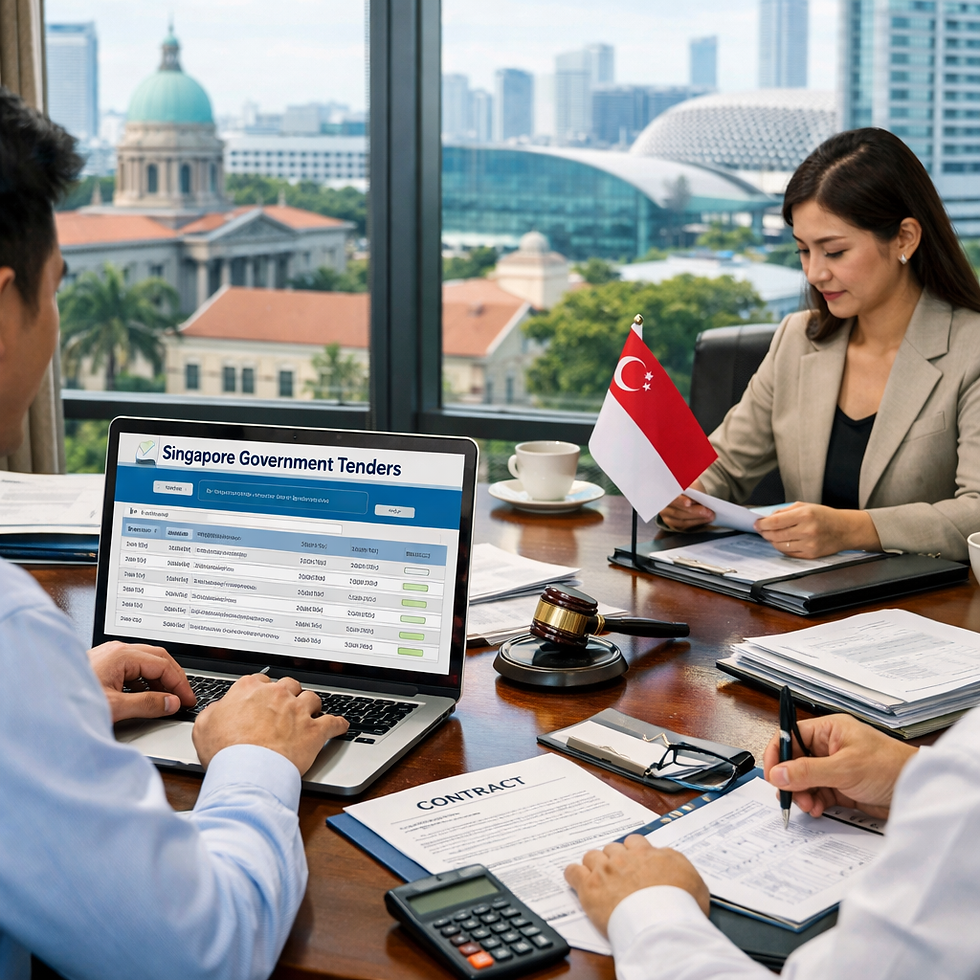
The Central Hub: GeBIZ and Its Role in Singapore Government Procurement
At the heart of Singapore's government procurement landscape is the Government Electronic Business System, known as GeBIZ . This is the official and primary platform where government agencies publish their procurement opportunities, ranging from simple quotations to complex multi-year tenders. As of September 15, 2026, GeBIZ actively lists 6,127 opportunities. This impressive volume includes open quotations, tenders, and "tender lite" notices, indicating a vibrant and continuous demand from the public sector. For any company serious about engaging with Singaporean government contracts, GeBIZ is the indispensable starting point.
GeBIZ serves not just as a listing portal but also as the designated channel for bid submissions. We've seen multiple tender notices in 2026, for instance, a Monetary Authority of Singapore (MAS) tender for "INVITATION TO TENDER FOR THE PURCHASE OF INFRASTRUCTURE AND SERVICES FOR SYSTEM TECHNOLOGY REFRESH (MAS-REQ-2026-000272/SY)", explicitly stating that submissions must be made electronically via GeBIZ. Another MAS notice, "CSD/T/26/AITOOL/MC/007", similarly emphasizes that all documents listed in Section 2 instructions "shall only be submitted via GeBIZ." This insistence on electronic submission underscores the digital-first approach of Singapore's procurement system, making online proficiency crucial for prospective bidders.
Beyond current opportunities, GeBIZ also offers a degree of transparency into past procurement activities. The Ministry of Finance's "Government Procurement via GeBIZ" dataset, for example, provides information on open tenders from Fiscal Year 2021 onwards, with data updated as recently as April 26, 2026, covering up to March 2026. While this dataset offers valuable insights into procurement trends and agency spending, it's important to distinguish between historical data and live opportunities. The "PPP listing" page on GeBIZ itself clarifies that its listings of indicative government procurement opportunities are for general information only and do not constitute an invitation to tender. Always look for active tender notices with specific deadlines and submission instructions.
Identifying Opportunities: What's Available in 2026?
The sheer volume of opportunities on GeBIZ can be both exciting and daunting. In 2026, the portal is buzzing with activity. Beyond the official GeBIZ platform, various tender aggregators also monitor and list Singaporean opportunities. One such aggregator reports approximately 1,000 live tenders in Singapore, drawing directly from e-tender notices, deadlines, and documents published on GeBIZ. This highlights the dynamic nature of public procurement here.
Specific examples from 2026 illustrate the breadth of current demand. The Ministry of Education, for instance, has a tender for digital audio workstations closing on July 21, 2026. The Housing & Development Board (HDB) is seeking bids for a design-and-build project, with a closing date of July 27, 2026. These examples show that opportunities span various sectors, from technology and education to infrastructure and construction. Companies with expertise in these areas should pay close attention to such listings.
Understanding the value band of a tender can also be critical for strategic bidding. A VITAL tender entry for "EPU/SER/17 - Service (Exhibition/Event Management)" from 2026, for example, indicates a procurement value of S$250,000 under EPU S3, with a closing date of August 3, 2026, at 4:00 PM. This information helps businesses gauge the scale of the project and decide if it aligns with their capacity and business objectives. Always look for these details within the tender documents themselves, as they provide essential context for your bid strategy.
Navigating GeBIZ: Practical Steps for Bid Submission
Once you’ve identified a promising opportunity on GeBIZ, the next step is to meticulously prepare and submit your bid. The process is highly formalized, and adherence to instructions is paramount. The repeated emphasis in 2026 tender notices that documents "shall only be submitted via GeBIZ" leaves no room for alternative submission methods. This means companies must be prepared for a fully electronic process.
Before even thinking about submission, ensure your company is registered on GeBIZ. This is a prerequisite for accessing tender documents, asking clarification questions, and ultimately submitting your proposal. The registration process typically involves providing company details and relevant business registrations. Once registered, you will be able to log in and access the full suite of functionalities.
When downloading tender documents, pay close attention to every detail. These documents will outline the scope of work, technical specifications, evaluation criteria, terms and conditions, and, crucially, the specific required submission format and content. For example, a tender might require a detailed technical proposal, a financial proposal, company profiles, past project references, and various statutory declarations. Missing any required document or failing to adhere to specified formatting can lead to disqualification, regardless of the quality of your actual offering.
Key Documents and Preparation for Singapore Tenders
Preparing a competitive bid for Singapore government tenders involves more than just writing a compelling proposal. It demands a systematic approach to documentation and a thorough understanding of the agency's requirements. While there isn't a single "2026 rulebook" title or act number readily available in snippets, the consistent instructions across various tenders provide a clear picture of what's expected.
Typically, you will need to prepare a range of documents. These often include a formal cover letter, a detailed technical proposal demonstrating your understanding of the project and your proposed solution, and a comprehensive financial proposal breaking down costs. Beyond these core components, expect to provide legal and administrative documents such as your company's business registration details, financial statements, insurance certificates, and any relevant licenses or certifications specific to the industry or service being tendered. References from previous clients, especially for similar projects, are also highly valued.
Crucially, every document must be prepared in English, as it is the official language for government procurement in Singapore. Ensure all figures, calculations, and technical specifications are clear, unambiguous, and easily verifiable. If you are an international bidder, you may need to have certain documents notarized or apostilled, depending on the specific tender requirements and your country of origin. Always check the tender's instructions to bidders for these specifics. Remember, the quality of your documentation reflects your professionalism and attention to detail, which are critical factors in the evaluation process.
Understanding the Evaluation Process and Local Culture
Singapore's procurement culture is characterized by its emphasis on fairness, transparency, and value for money. While price is always a consideration, it is rarely the sole determinant. Government agencies often employ a "quality-price" or "best value" approach, where technical merit, proposed methodology, experience, and sometimes even social or environmental considerations are weighed alongside cost.
The evaluation criteria will always be clearly outlined in the tender documents. Pay close attention to the weighting given to different aspects, such as technical solution, experience of key personnel, project timeline, and proposed cost. Your bid should be structured to address each criterion explicitly, providing evidence and justification for your claims. Simply stating you can do the job is not enough; you need to demonstrate how and why your company is the best fit.
A key aspect of the local procurement culture is meticulous adherence to instructions. Singaporean government agencies expect bidders to follow every instruction precisely. This includes formatting, submission deadlines, and the specific content required for each section of the proposal. Any deviation, no matter how minor it may seem, can be grounds for disqualification. This isn't about being overly bureaucratic; it's about ensuring a level playing field and efficient evaluation. For international companies, this might mean adjusting to a more formal and structured bidding process than they are accustomed to in other regions.
Leveraging TendersGo for Broader Reach and Efficiency
While GeBIZ is the official portal, keeping track of every new opportunity can be time-consuming, especially when operating across multiple markets. This is where a powerful tool like TendersGo.com becomes invaluable. As the world's largest tender search engine, TendersGo aggregates opportunities from over 220 countries and in 145 languages, including, of course, a comprehensive listing of Singapore tenders.
For businesses targeting Singapore, TendersGo offers several features that streamline the tender search process. You can set up unlimited alerts based on specific keywords, CPV/NAICS codes, or regions, ensuring you never miss a relevant opportunity. Imagine receiving an instant notification when a new Ministry of Education digital audio workstations tender or an HDB design-and-build project is published – that's the efficiency TendersGo provides. The platform also offers AI summaries of tender documents, helping you quickly grasp the essence of complex bids without having to read through hundreds of pages initially.
Furthermore, TendersGo allows for PDF viewing of original tender documents, facilitating easy access and analysis. Its B2B marketplace can also connect you with potential partners or suppliers, which can be particularly useful for forming consortia for larger tenders. With saved searches and a free 30-day trial, TendersGo empowers businesses to proactively identify and respond to opportunities, not just in Singapore but globally. It acts as a powerful complement to GeBIZ, expanding your visibility and significantly reducing the time spent on manual searching, allowing you to focus more on crafting winning proposals.
Key Deadlines and Staying Compliant in 2026
In the world of government procurement, deadlines are absolute. There is generally no grace period for late submissions, and missing a deadline, even by a minute, will almost certainly result in your bid being rejected. This is a universal truth in public tendering, and Singapore is no exception. As we've seen with the Ministry of Education's digital audio workstations tender closing on July 21, 2026, and the HDB design-and-build tender closing on July 27, 2026, these dates are firm and non-negotiable.
It is always advisable to aim for submission well in advance of the deadline. Technical glitches, internet issues, or unexpected problems with the GeBIZ platform can occur, and attempting to submit just minutes before the cut-off is a high-risk strategy. Many experienced bidders aim to submit at least 24 to 48 hours before the official closing time, allowing ample buffer for any unforeseen circumstances. This proactive approach minimizes stress and ensures your meticulously prepared bid reaches the agency on time.
Beyond the submission deadline, be aware of other critical dates, such as deadlines for clarification questions. Most tenders allow a period for bidders to ask questions to the procuring agency to clarify any ambiguities in the tender documents. Utilizing this period effectively can be crucial for understanding the exact requirements and avoiding misinterpretations. Responses to these questions are usually shared with all bidders, ensuring fairness. Staying informed and compliant with all published timelines is not just about meeting administrative requirements; it's about demonstrating your reliability and professionalism, qualities highly valued by Singaporean government agencies.