
Germany Public Procurement 2026: Supplier Bid Guide

Germany's public procurement landscape in 2026 presents both significant opportunities and distinct challenges for international suppliers. For bid managers, export managers, procurement officers, and project developers looking to enter or expand their footprint in one of Europe's largest economies, understanding the intricacies of the German system is paramount. This supplier bid guide will walk you through the essential elements of Germany public procurement 2026, from navigating EU thresholds and federal portals to understanding local requirements and recent policy changes, helping you prepare a competitive bid.
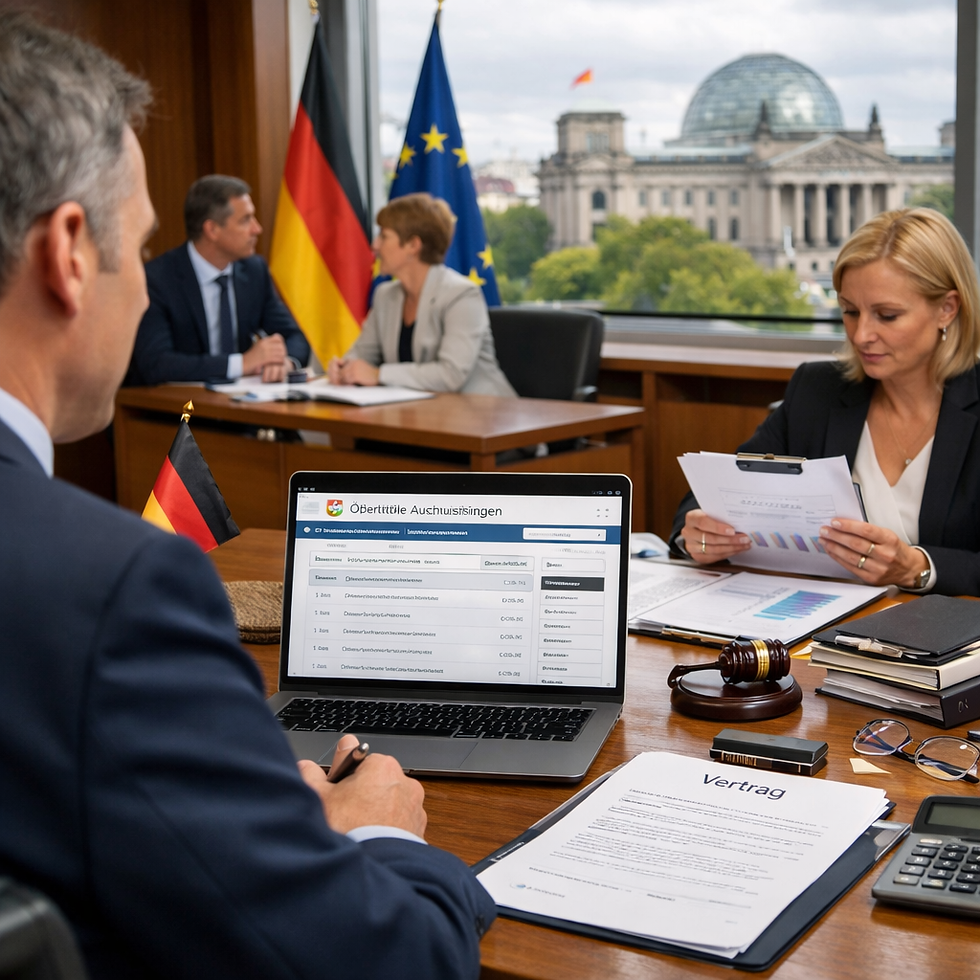
The German market, while highly regulated, offers a stable and transparent environment for public contracts. However, its decentralized nature means there is no single, monolithic German tender portal. Instead, a patchwork of EU, federal, and regional platforms requires a strategic approach to tender identification and submission. This guide aims to demystify that process, offering practical insights for how to bid in Germany effectively.
Understanding the German Procurement Ecosystem in 2026
Entering the German public procurement market demands a clear grasp of its structure. Unlike some countries with a centralized national portal, Germany operates a multi-tiered system. You'll find tenders published at the European Union level, the federal level, and across numerous regional and municipal authorities. This decentralized approach means your search strategy needs to be comprehensive, touching on various platforms to ensure you don't miss opportunities.
For instance, federal notices are consistently published on Bund.de and the central publication service oeffentlichevergabe.de . These are critical starting points for any supplier targeting federal contracts. For tenders exceeding certain values, the EU-wide portal, TED (Tenders Electronic Daily) , becomes the primary publication channel. This dual system for federal and EU-level tenders means suppliers must monitor both to get a complete picture of available opportunities. Regional and municipal tenders, below the EU thresholds, are often found on regional portals or even directly on the websites of individual contracting authorities.
The sheer volume of tenders can feel overwhelming. This is where a robust search strategy comes into play. Tools like TendersGo, with its coverage of 220+ countries and 145 languages, can be invaluable for aggregating opportunities. Its AI summaries, unlimited alerts, and CPV/NAICS code filtering can help you cut through the noise and identify relevant tenders quickly, regardless of where they are published within Germany's complex system.
Key Procurement Thresholds and Their 2026 Updates
The financial thresholds for public procurement in Germany are directly linked to EU regulations, and these underwent significant changes at the beginning of 2026. These updated EU procurement thresholds, published in the EU Official Journal on October 23, 2025, apply to all procedures published or otherwise initiated from January 1, 2026. Understanding these figures is fundamental, as they dictate which procedural rules apply and where a tender must be published.
Supplies and Services: For most contracting authorities, the threshold is now EUR 216,000. However, for upper and federal authorities, this drops to EUR 140,000. This distinction is crucial; a federal ministry buying office supplies has a lower threshold for EU-wide publication than a municipal government buying the same.
Specific Sectors (Utilities, Defense, etc.): Here, the thresholds are higher. For supplies and services in these sectors, it's EUR 432,000. Social and other special services have an even higher threshold of EUR 1,000,000.
Works Contracts (Construction): A substantial threshold of EUR 5,404,000 applies across all listed categories for construction projects. This means large infrastructure projects will almost certainly be subject to EU-wide tendering rules.
Concessions: Similar to works contracts, concessions also have a threshold of EUR 5,404,000.
These thresholds are not merely administrative details; they fundamentally shape the tendering process. Tenders above these values typically follow more stringent EU-level procedures, including longer publication periods and broader advertising, ensuring greater competition across the EU single market. For suppliers, this means more time to prepare bids but also more competitors to contend with. Below these thresholds, national rules often apply, which can sometimes be simpler or more tailored to local market conditions, though still requiring diligence.
Navigating German Procurement Portals and Platforms
As established, there's no single German tender portal. This fragmented landscape requires suppliers to be strategic in their search. Fortunately, several key platforms serve as primary hubs for different types of tenders. Understanding where to look is half the battle won.
For large-scale, EU-relevant tenders, TED (Tenders Electronic Daily) is indispensable. This is where all contracts exceeding the EU thresholds are published, ensuring transparency and competition across the European Economic Area. Monitoring TED is essential for any company aiming for significant contracts in Germany.
Domestically, federal-level opportunities are primarily found on Bund.de and oeffentlichevergabe.de . These platforms serve as official publication channels for various federal ministries and agencies. While some tenders here might fall under EU thresholds, many will still be significant in value and scope, representing substantial business opportunities.
Beyond these official government portals, several commercial and semi-commercial platforms aggregate tenders from various sources. The Deutsches Vergabeportal (DTVP) , operating at dtvp.de (or en.dtvp.de for English speakers), is a prime example. DTVP proudly states it's used by "more than 5,000 German contracting authorities" and serves "over 160,000 companies worldwide." They claim to offer access to "nearly 100% of public tenders" across sectors, making it a powerful tool for comprehensive tender identification.
Individual contracting authorities also often maintain their own e-procurement platforms or publish tenders on their websites. For instance, the Fraunhofer Society, a major research organization, states national tenders are on Bund.de, EU tenders on TED, and bidders can register on vergabe.fraunhofer.de or Deutsche eVergabe . This illustrates the need for a multi-pronged search strategy and highlights how some organizations might use a mix of official and proprietary channels. For development cooperation procurements, GIZ, for example, uses its own e-procurement tender platform for services, construction, and supplies in Germany, adhering to German and European procurement law.
For a truly comprehensive search, especially across diverse regions and sectors, a service like TendersGo can consolidate results from all these disparate sources. Imagine having AI summaries of relevant tenders, delivered straight to your inbox, regardless of whether they originated on TED, Bund.de, DTVP, or a specific municipality's portal. This centralized approach saves countless hours of manual searching across dozens of sites, allowing you to focus on preparing your bid.
Key Policy and Regulatory Changes in 2026
The German public procurement landscape is dynamic, with several significant policy changes taking effect in 2026. Keeping abreast of these reforms is vital for ensuring compliance and understanding the evolving strategic priorities of German contracting authorities.
One of the most impactful changes is the reported entry into force of Germany’s Public Procurement Acceleration Act on July 1, 2026. This act specifically applies to procurement above the EU thresholds, indicating a governmental drive to expedite larger public projects. For suppliers, this could mean faster tender processes, potentially shorter bidding windows for certain stages, and a greater emphasis on efficiency from contracting authorities. While the full details of its implementation will become clearer, the intent is to streamline bureaucratic hurdles for major projects, making the process more agile.
Another significant development concerns sub-threshold procurement. A draft reform of the subthreshold procurement rules (UVgO) was reported in September 2026. This reform proposes a new threshold of EUR 100,000 and aims to introduce additional exceptions to expand the discretion of contracting authorities for smaller contracts. This could simplify procurement for lower-value goods and services, potentially allowing for more direct awards or simplified procedures below this new threshold. For smaller and medium-sized enterprises (SMEs), this might open up more accessible opportunities, reducing the administrative burden often associated with formal tendering processes.
In the defense sector, 2026 also sees the application of the BwBBG 2026 . This specific legislation introduces special accelerated procurement rules for all Bundeswehr (German Armed Forces) requirements in the above-threshold sector. Given the current geopolitical climate, this highlights a strategic national focus on rapid and efficient procurement for defense needs. Suppliers in the defense industry should pay close attention to Bundeswehr tenders, as these accelerated procedures may require quicker responses and a readiness for fast-tracked project execution.
Finally, even at the municipal level, regulatory updates are occurring. For example, the City of Bonn’s procurement bylaws, which took effect on September 1, 2026, apply to contracts below the EU thresholds, specifically referencing § 106 of the German Act Against Restraints of Competition (GWB). This illustrates that local regulations, while adhering to overarching federal and EU principles, can introduce specific nuances. Always check the particular contracting authority's bylaws and terms, especially for sub-threshold procurements, as local procurement cultures can vary.
Essential Documents and Qualification Requirements
Successfully bidding for German public contracts requires meticulous preparation of documentation and a clear understanding of qualification criteria. German procurement authorities are known for their thoroughness, and incomplete or incorrect submissions are often grounds for disqualification. This section outlines the typical documents and requirements you'll encounter.
Standard Documents for Tender Submission
Declaration of Eligibility (Eigenerklärung zur Eignung): This is often a preliminary self-declaration confirming your company meets basic eligibility criteria, such as not being in bankruptcy, having paid taxes, and not being involved in criminal activities.
Company Registration Documents: Proof of legal existence, such as an extract from the commercial register (Handelsregisterauszug). For international companies, an equivalent document from your home country's company registry is usually required, often with an official German translation.
Financial Standing Proof: Evidence of your company's economic and financial capacity. This typically includes annual financial statements (balance sheets, profit and loss statements) for the last three years, bank statements, or proof of liability insurance. Contracting authorities want assurance you can financially sustain the contract.
References from previous similar projects, often requiring client contact details for verification.
Lists of key personnel, their qualifications, and professional experience (CVs).
Certifications (e.g., ISO 9001 for quality management, ISO 14001 for environmental management) relevant to the nature of the contract.
Proof of technical equipment, infrastructure, or facilities.
Tax Clearance Certificates: Confirmation from your tax authorities that all taxes and social security contributions have been paid.
Insurance Policies: Proof of relevant insurance coverage, such as professional indemnity insurance, public liability insurance, and employer's liability insurance.
Declaration of Compliance: A statement that your company complies with all applicable labor laws, environmental regulations, and ethical standards, including anti-corruption policies.
Power of Attorney (Vollmacht): If the bid is signed by someone other than a legally registered company representative, a power of attorney is necessary.
Joint Venture/Consortium Agreements: If bidding as part of a consortium, the formal agreement outlining responsibilities and liabilities between partners.
Many of these documents will need to be provided in German, or at least accompanied by certified German translations. It's a critical aspect of local procurement culture to provide clear, legally binding documentation. Missing a single required document or failing to provide an adequate translation can lead to immediate disqualification. Starting the preparation of these documents well in advance of any specific tender is a smart move.
Furthermore, many German contracting authorities now utilize electronic submission platforms, which might have specific formatting requirements for documents. Familiarize yourself with these platforms early, perhaps through test submissions if available, to avoid last-minute technical glitches.
The German Procurement Culture: What to Expect
Beyond the legal frameworks and technical requirements, understanding the prevailing procurement culture in Germany can significantly enhance your chances of success. German procurement is characterized by a strong emphasis on precision, adherence to rules, and transparency.
Punctuality and Precision: Germans value punctuality. Tender deadlines are absolute; late submissions are almost universally rejected without exception. Similarly, precision in your documentation and bid proposal is paramount. Any ambiguity, inconsistency, or error can be viewed critically. Double-check all calculations, specifications, and legal references. This meticulousness extends to the language; while many international tenders are available in English, providing documents in German (or certified translations) demonstrates respect for the local context and attention to detail.
Transparency and Fairness: The German procurement system is designed to be highly transparent and fair. This means that all bidders should receive equal information, and evaluation criteria are typically clearly defined. There is little room for informal lobbying or deviation from established processes. Decisions are based strictly on the published criteria, making it crucial that your bid directly addresses each point in the tender documents.
Quality and Value for Money: While price is always a factor, German contracting authorities often prioritize quality, reliability, and long-term value over the lowest possible cost. They expect robust solutions, high-quality materials, and dependable service. Highlighting the durability, efficiency, and sustainability aspects of your offering can be a strong selling point. Demonstrating a clear understanding of the project's long-term operational costs and benefits will be more impactful than simply offering the cheapest option.
Professionalism and Compliance: A high degree of professionalism is expected throughout the bidding process. This includes clear communication, prompt responses to queries, and strict adherence to all legal and ethical standards. Compliance with German labor laws, environmental regulations, and data protection rules (such as GDPR) is not just a legal requirement but a cultural expectation. Prove your commitment to these standards in your bid.
Long-Term Relationships: While initial contracts are awarded competitively, German organizations often seek to build long-term relationships with reliable suppliers. A successful first contract can open doors to future opportunities. Delivering on promises, maintaining high standards, and providing excellent post-contract support can solidify your position in the market.
Engaging with the German procurement culture means embracing its emphasis on order, quality, and adherence to process. It might seem rigid to some, but for those who master it, it offers a predictable and trustworthy environment for securing public contracts.
Leveraging TendersGo for German Opportunities
Given the fragmented nature of German public procurement, a powerful search and notification tool becomes not just useful, but essential. This is where TendersGo can significantly streamline your efforts to find and manage German tender opportunities.
Imagine trying to manually monitor TED, Bund.de, oeffentlichevergabe.de, DTVP, and potentially dozens of regional portals and individual contracting authority websites. The time and resources required would be immense. TendersGo, as the world's largest tender search engine, centralizes this process. It covers over 220 countries and processes tenders in 145 languages, ensuring you don't miss opportunities regardless of their origin within the German system.
Here’s how TendersGo specifically addresses the challenges of German procurement:
Comprehensive Coverage: TendersGo aggregates tenders from all the key German platforms – EU-level (TED), federal (Bund.de, oeffentlichevergabe.de), and numerous regional/municipal sources, including commercial aggregators like DTVP. This means you get a holistic view of the market without having to jump between multiple sites.
Intelligent Filtering: Utilize CPV/NAICS codes to precisely filter for tenders relevant to your industry. This is particularly valuable in a market as diverse as Germany's, allowing you to quickly identify opportunities for supplies, services, or construction work.
AI Summaries: Get quick, digestible AI summaries of complex tender documents. This helps you rapidly assess the relevance and scope of a tender, saving valuable time you'd otherwise spend sifting through lengthy German legal texts.
Unlimited Alerts: Set up saved searches and receive unlimited alerts directly to your inbox. This ensures you're immediately notified of new tenders that match your criteria, giving you a competitive edge by allowing you to react quickly to new opportunities, especially with potentially accelerated procedures under new 2026 legislation.
PDF Viewing and Management: Access and manage tender documents directly within the platform, making it easier to organize your bidding process.
B2B Marketplace: Explore potential partnerships or subcontracting opportunities within the TendersGo B2B marketplace, which can be particularly useful for navigating complex German projects or fulfilling local content requirements.
For bid managers and export managers, the ability to centralize tender discovery and receive targeted alerts is a game-changer. Rather than being buried in administrative searches, you can dedicate more time to crafting compelling proposals that meet Germany's high standards. If you're serious about entering or expanding in the German public procurement market, a free 30-day trial of TendersGo is an excellent way to experience these benefits firsthand and streamline your 2026 bidding strategy.





